


One Ring to Track Them All
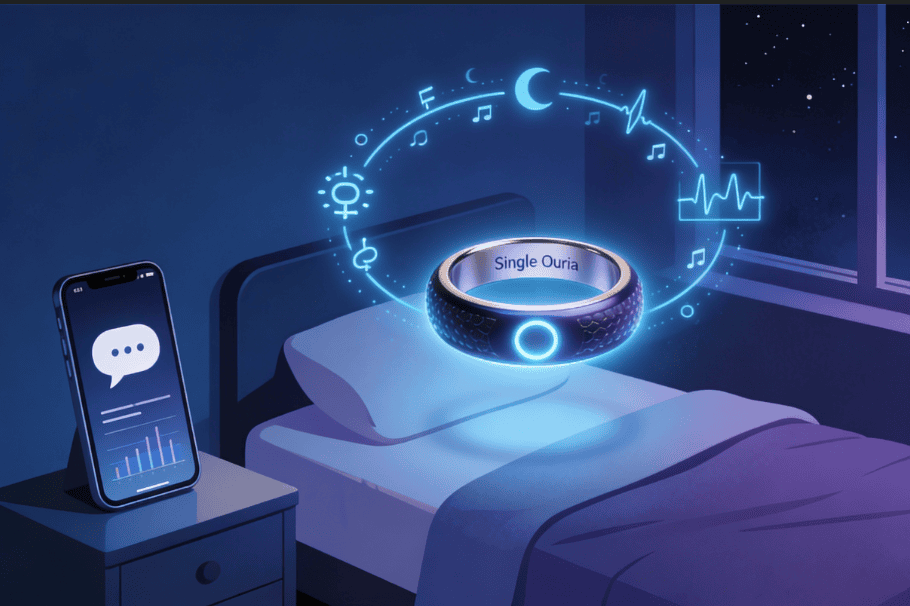
It’s not the One Ring enslaving everyone – it’s a small titanium band on my finger that has been politely, but relentlessly, confronting me with numbers for almost twelve days. No fiery lidless eye, just a sleep nerd that tells me every morning how serious (or not) my body took my longevity plan the night before (science here).
In this little field report, the Oura Ring plays the role of nocturnal data collector – and Perplexity, my AI assistant, acts as the chatty, occasionally brutal analyst explaining what I’m actually doing to my REM, deep sleep and brain. Together we’ve run a series of experiments: ditching my Kindle before bed, banning the phone from the pillow, and stress‑testing my sleep with an evening at the pub.
How the Ring Took Over My Bedroom
Oura is built first and foremost as a sleep tracker, not a glorified step counter. It measures heart rate, heart rate variability (HRV), skin temperature and movement, and reconstructs every night into a hypnogram of wake, light, deep and REM sleep. Each morning I get a Sleep Score and a neat breakdown of how much of the night I actually spent in useful sleep versus just negotiating with my mattress.
From the first twelve days, a few patterns stood out:
- Nights with 8+ hours of sleep, efficiency ≥ 85 %, around 25 % REM and 17 % deep sleep earned Sleep Scores close to 90 – and I rated my mental sharpness as a “2 out of 5” (where 1 = excellent and 5 = bad). That’s my current personal optimum.
- Nights with roughly 5.5–6.5 hours of sleep, efficiency below 80 % and REM in the single digits looked like seismograph plots after an earthquake – and felt like a “4 out of 5” morning.
- In between sits a broad middle: 7+ hours, REM and deep sleep at the lower end of recommended ranges, scores in the 70s and 80s, and me feeling “fine but not great”.
The ring doesn’t care how I feel about my night. It counts REM minutes and deep‑sleep windows. My job is to reconcile those curves with my subjective reality.
My AI Sidekick: Perplexity as Sleep Interpreter
This is where my AI co‑author comes in. While Oura silently records, I sit down with Perplexity each morning and feed it my nightly stats: total sleep time, efficiency, REM and deep percentages, HRV, oxygen levels, plus my own 1–5 rating of how sharp I feel.
In return, the AI delivers:
- Context. Oura’s “nice green bars” get mapped onto sleep science: adults typically spend about 20–25 % of sleep in REM and roughly 13–23 % in deep sleep if things are going well.
- Interpretation. On a night with 5:46 h of sleep, 11 % REM and 9 % deep sleep, Oura screamed “bad night”, while I felt oddly fine. Perplexity pointed to a high HRV, a very relaxed evening, full‑moon effects and the fact that we humans are terrible at noticing micro‑awakenings.
- Reality checks. When I went to the pub and had three beers, Oura logged a short, fragmented night with REM down to about 9–11 % and lower efficiency; Perplexity calmly pulled up the studies showing alcohol consistently reduces and delays REM and worsens sleep quality.
The result is a running dialogue: the ring measures, the AI translates, and I sit in the middle, mildly embarrassed whenever my “I sleep just fine” narrative collides with a chart showing half the REM I thought I was getting.
Experiments in the Bedroom Lab
Instead of just wearing Oura passively, I treated the last twelve days as a small personal sleep lab.
1. Kindle and Phone: Blue Light vs. Deep Sleep
On some evenings, I went screen‑free in bed. On others, I read on my Kindle for 60–90 minutes or scrolled on my phone for about 15 minutes right before trying to sleep.
What the data showed:
- Screen‑free nights (no Kindle or phone in bed) were the strongest: sleep efficiency at or above 87–88 %, REM around 20–25 %, deep sleep roughly 15–20 %, scores close to 90, and very clear mornings.
- Phone‑in‑bed nights (even just 15 minutes) still gave okay scores, but REM hovered around 16 % and deep sleep around 13–14 % – good, but consistently less “premium” than the screen‑free configuration.
Large studies on light‑emitting devices before bedtime confirm this: evening screen use suppresses melatonin, delays circadian timing, and reduces deep and REM sleep, especially in the first half of the night.
2. Alcohol: Three Beers as a REM Shredder
For a cyber‑audience you need a proper stress test, so I did what any responsible self‑experimenter does: I went to the pub.
- On the three‑beer night, Oura recorded about 6.5 hours of sleep, ~77 % efficiency, REM around 9–11 % and deep sleep barely in the normal range. I woke up feeling notably worse: a clear “4 out of 5”.
- On similar nights without alcohol, but with my usual routine (early dinner, tea, no screens in bed), I got 7.5–8+ hours, efficiency ≥ 85 %, 20–25 % REM, 15–20 % deep sleep, and a steady “2 out of 5” in the morning.
Perplexity pointed me to the literature: alcohol acts as a sedative early in the night but reduces overall REM, delays its onset and fragments sleep later in the night. In other words, that last round at the bar shows up as missing brain‑maintenance in the hypnogram.
3. Tea, Chocolate and the Midnight Bathroom Run
My current “clean evening” protocol – which repeatedly produced 2‑out‑of‑5 mornings and high Sleep Scores – looks like this:
- last meal between 18:00 and 18:30,
- a few pieces of 70 % dark chocolate directly after dinner,
- homemade cinnamon–clove–star anise–ginger tea, followed by chamomile, with the last sip around 20:30,
- then no further fluids to reduce nocturnal bathroom trips.
On these nights, I’ve consistently seen:
- 7.5–8.2 hours of sleep,
- efficiency ≥ 84 %,
- REM between 16–25 %, deep sleep 13–20 %,
- at most one bathroom visit and a clearly better subjective state.
On evenings with the same teas but too much liquid too late, I woke up two or more times to use the bathroom, and both sleep efficiency and my morning rating dropped – a pattern reflected in research on nocturia and sleep fragmentation.
What the Ring Is Teaching My Longevity Brain
After less than two weeks, a few uncomfortable but useful lessons have crystallized:
- Sleep is the foundation, not an accessory. Without 7–8 reasonably clean hours – including enough REM for memory and emotional processing and enough deep sleep for physical and neural repair – the rest of the longevity toolkit is largely cosmetics.
- Subjective sleep is noisy. I’m quite good at spotting disasters versus great nights, but the subtle middle (where performance is lost or gained) hides in the data: missing 30–60 minutes of REM or deep sleep isn’t obvious without a tracker.
- Tiny behavior changes have outsized impact.
- No screens in bed,
- early, light dinner,
- minimal alcohol,
- controlled evening fluids and calming teas
systematically shifted my Sleep Scores by 5–10 points and made the difference between “fine” and “actually sharp” the next morning.
Oura collects the evidence; Perplexity cross‑checks it with sleep science and reminds me – without being patronizing – that my previous “I sleep kind of okay” story was about as rigorous as a random altcoin whitepaper.
Where This Experiment Goes Next
The plan from here:
- Build small datasets comparing screen‑free vs. screen‑in‑bed nights,
- alcohol vs. no‑alcohol evenings,
- different tea volumes and timing.
- Tie these patterns more tightly to next‑day cognitive load: complex writing, investigations, heavy analytical work.
The ring doesn’t “enslave” me, but it does quietly dictate my evening choices via data. And the AI sitting on my other screen is more than happy to annotate every graph with research papers and gentle sarcasm.
Future instalments for The Cyber Voice will dig into these patterns with more nights and more variables – jet lag, travel, heavy workouts, maybe the occasional controlled pub night. Assuming, of course, I don’t sleep through my own deadlines.