



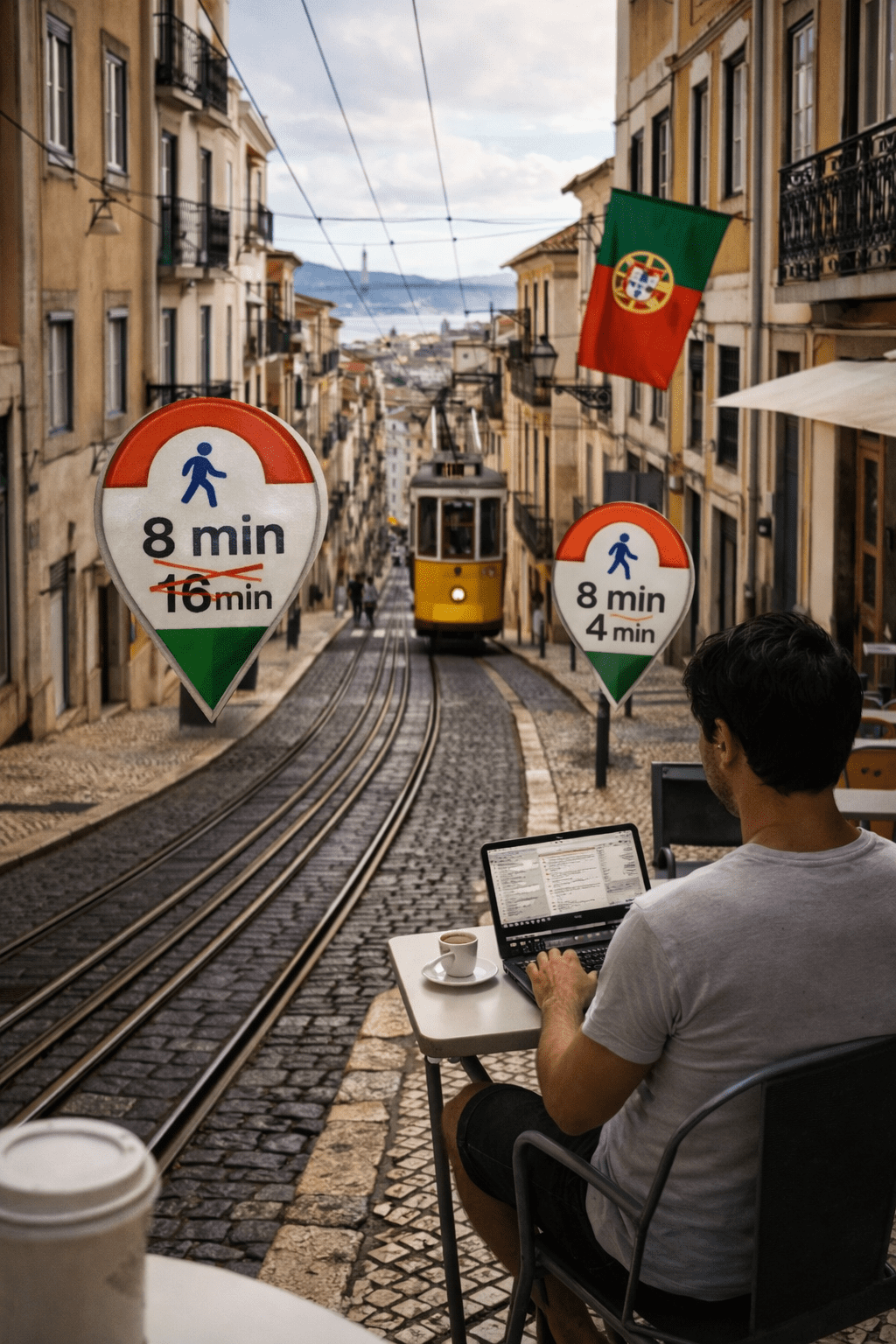
Lisbon is a beautiful city. It is also a very vertical one. And that single fact quietly changes how you work, plan, and move through your day.
Why Google Maps Lies in Lisbon
In flat cities, Google Maps is reliable. In Lisbon, it’s optimistic.
If a route goes downhill, you can usually trust the estimate. Sometimes you even arrive faster than expected.
If it goes uphill, forget the number. Double it.
Steep streets, stairs that don’t show up on the map, and gradients that turn short distances into slow progress make time estimates theoretical at best.
The Hidden Cost for Remote Work
This becomes relevant the moment you try to structure a workday.
Lunch meeting at noon. Call at 2 p.m. Quick walk to a café in between.
On paper, it works. In Lisbon, it often doesn’t.
Moving between locations takes longer than expected — not because of distance, but because of elevation. That extra effort adds friction to an otherwise flexible day.
Why Buffers Matter More Than Punctuality
Arriving late to a meeting because you underestimated a hill can be a funny anecdote. Once.
Not every business call appreciates a story about staircases and gravity.
The practical solution is simple: add buffer.
More buffer than you think you need. Especially if you plan to move between cafés, restaurants, and workspaces.
Coffee as Infrastructure
One clear advantage of working in Lisbon is coffee.
Espresso often costs around one euro. Sometimes less.
At that price point, cafés become extensions of your home office. The cost difference between making coffee at home and ordering one outside is negligible.
The atmosphere, however, is not.
Lisbon’s cafés offer movement, background noise, and a sense of rhythm that makes long workdays easier to manage.
Afterwork Reality: Beer Prices Tell the Truth
If coffee feels local, beer feels Western European.
After-work drinks usually land between four and five euros. Comparable to Italy.
Not expensive — but not a bargain either.
Lisbon may be relaxed, but it’s not cheap across the board. The illusion of affordability fades quickly once work ends.
What Lisbon Optimizes For
Lisbon is optimized for living slowly.
It rewards walking, sitting, observing, and staying longer than planned. It does not optimize for tight schedules or back-to-back meetings.
Trying to impose strict efficiency on the city usually backfires. Adapting your pace works better.
Final Thought
Lisbon doesn’t challenge your productivity directly.
It challenges your assumptions about time.
If you respect the hills, plan buffers, and treat cafés as infrastructure rather than distractions, the city becomes workable.
Ignore those rules, and Lisbon will quietly rearrange your calendar for you.