


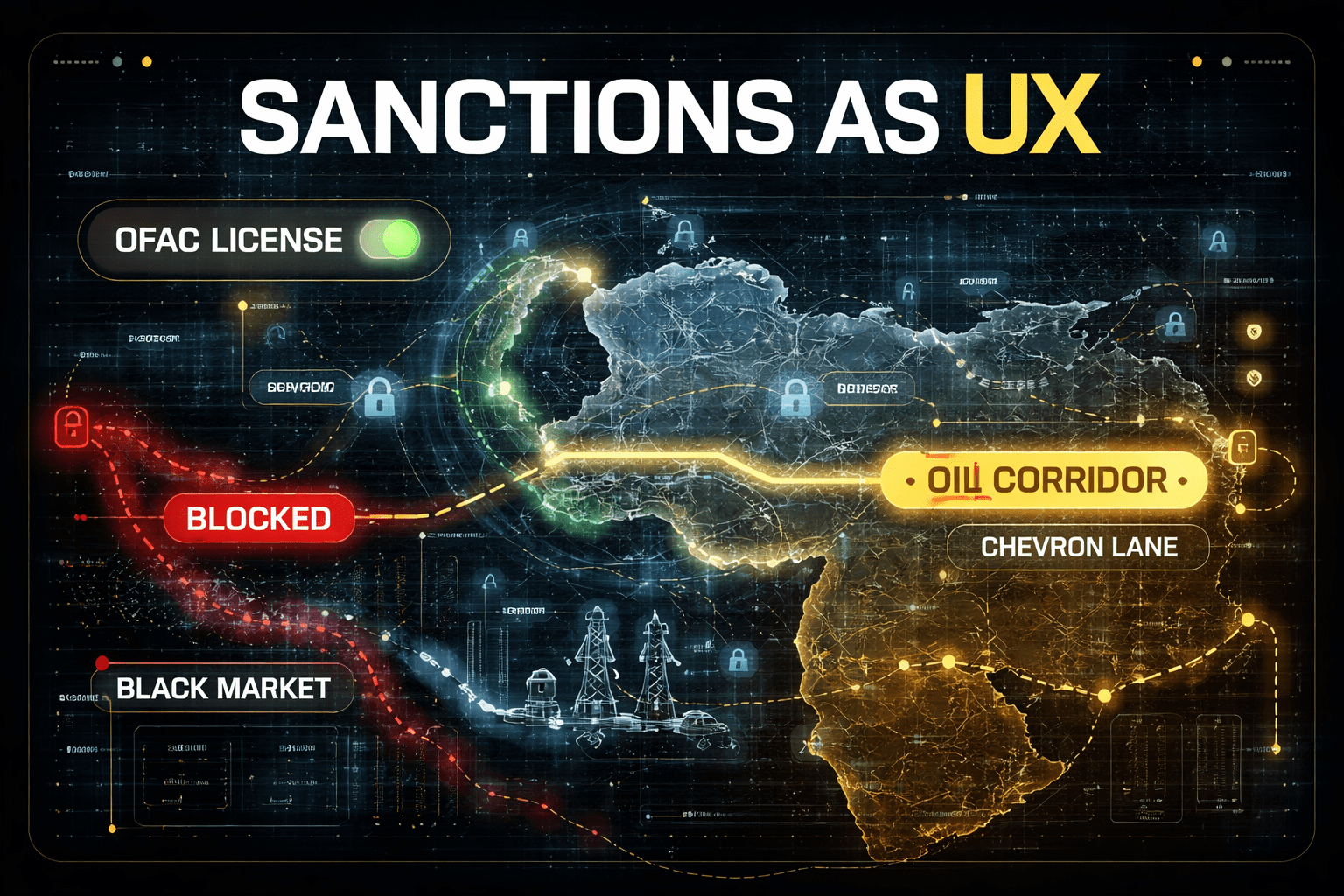
Sanctions are marketed as moral policy. In practice, they behave like software design: permissions, friction, “allowed flows,” and hidden admin menus. Venezuela is the cleanest demo.
Why it matters
Once you see sanctions as user experience, you stop asking “Is it tough?” and start asking: Who gets the VIP lane? Who gets routed into the gray market? That’s the real geopolitical outcome.
- Sanctions are UX: permissions, friction, and VIP lanes.
- Licenses (like GL 44/44A) are the buttons that decide reality (Source: OFAC)
- Watch the corridors: when sanctions “change,” the interface rarely disappears—it gets redesigned.
TL;DR
Sanctions aren’t just policy—they’re an interface that creates “allowed flows,” and Venezuela shows how licensing becomes the real power layer.
“Sanctions don’t just block money. They redesign what is possible.”
Key points
- Licenses are the interface. OFAC’s General License 44 (and later 44A) functioned like a temporary “feature unlock” for parts of Venezuela’s oil and gas transactions—then got replaced by a wind-down (Sources: OFAC, OFAC).
- One company becomes a protocol. Chevron’s Venezuela license is effectively a sanctioned corridor—tightened or loosened depending on Washington’s objectives (Source: Reuters).
- 2026 looks like a new UI test. Reuters (citing a CNBC report) says the U.S. may continue Venezuelan oil sales to the U.S. “indefinitely” alongside sanctions easing—an abrupt shift if confirmed (Source: Reuters).
The Angle
Think of sanctions like a platform redesign: you don’t “ban the app,” you throttle the payment rails, break integrations, and force users into workarounds. The result is predictable. A permissioned economy emerges—where compliance access becomes a tradable commodity. Licenses, exemptions, wind-downs, and “authorized transactions” aren’t footnotes; they’re the buttons on the screen that decide what is possible.
And here’s the part nobody likes to say out loud: sanctions don’t only “punish.” They also create markets—for intermediaries, for fixers, for controlled channels, for the right paperwork at the right time. If the Reuters/CNBC reporting about a major oil arrangement is even partly accurate, that’s not “sanctions ending.” It’s sanctions evolving into a managed corridor: the state as product manager, deciding who gets access and under what terms. Reuters+1
Counterpoint
Yes: sanctions can be a non-military tool that signals condemnation and limits funds flowing to abusive regimes. And sometimes they do constrain capabilities. But the UX lens reveals the hidden cost: when official rails close, unofficial rails don’t disappear—they get more expensive, more corruptible, and harder to audit.
The Wink/Conspiracy Corner
Every empire eventually ships a “stability update” that mostly changes the menu.